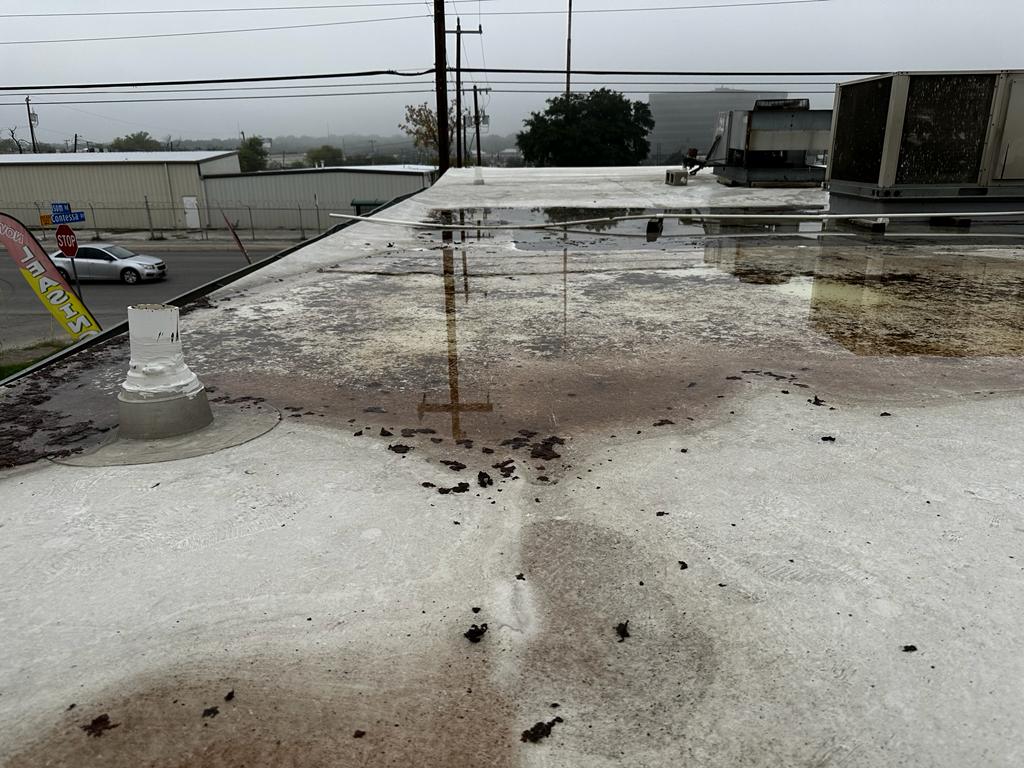
Standing water on a Dallas commercial flat roof is not a cosmetic problem. Chronic ponding degrades every layer of the roofing system from the membrane down to the deck — and the damage is usually worse than it looks from the roof surface.
Dallas gets 37 inches of rain per year on average, often in concentrated bursts — three inches in two hours during spring squall events is not unusual. Flat roofs that cannot drain those volumes fast enough end up with ponding water that sits for 48-72 hours after the storm. That ponding is not just a performance problem in the moment: it is a long-term degradation process that runs on every standing hour.
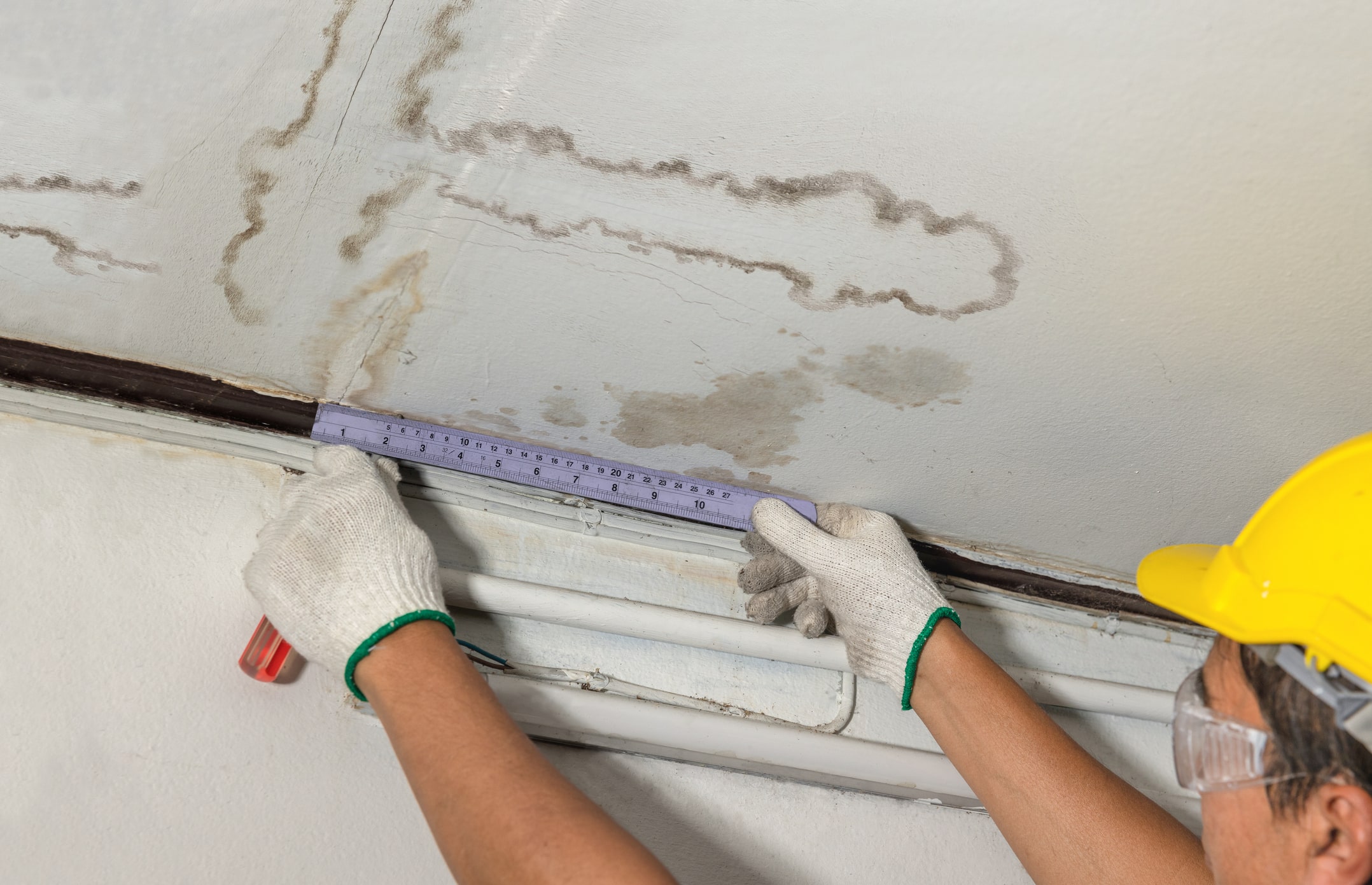
The sequence is predictable. Chronic ponding degrades the membrane UV resistance at the waterline, accelerating surface oxidation above the water level. Algae and biological growth colonize the ponding zone, producing acids that attack the membrane surface. Drain bodies that sit in ponded water develop accelerated corrosion at the metal components and sediment accumulation in the drain body that compounds the drainage problem. Insulation beneath the membrane in chronic ponding zones absorbs moisture through micro-perforations that accumulate over time. And the deck below wet insulation — especially metal deck — corrodes at the flute valleys where the water concentrates.
We assess ponding water damage the same way we assess any other roof damage: systematically, with documentation that shows what is actually happening in each layer of the system.
Most Dallas commercial flat roof ponding problems trace to the drain system: undersized drains for the roof area, drains that have accumulated debris and sediment, drain bodies with corroded clamping rings that no longer seat properly, and drain dome strainers that are missing or packed with debris. Any one of these reduces the drain's effective flow rate — and when the flow rate drops below the design storm's rainfall intensity, ponding begins.
Drain failure does not just produce ponding. It produces a cascade: the ponding zone expands each rain event as sediment accumulates further, the membrane at the drain edge works under hydrostatic load that standard membrane attachment is not designed for, and the interior drain body — if it is a two-piece cast-iron drain on an older Dallas building — develops a clamping ring leak that allows water to bypass the drain body entirely and enter the building at the drain penetration. We inspect all drains on any roof with ponding evidence, and we document both the drain condition and the downstream damage.
Moisture in the roofing insulation cannot be reliably identified from the roof surface — the membrane may look intact while the insulation below has been saturated for years. We map moisture in roofing insulation using two methods: infrared thermal scanning (conducted at dusk or dawn, when the temperature differential between wet and dry insulation is greatest) and moisture core pulls at suspect locations confirmed by the thermal scan.
Thermal scanning identifies the extent of moisture distribution. Core pulls confirm the moisture and quantify how far through the insulation stack the saturation has penetrated. A roof with localized insulation saturation confined to two zones can often be repaired: cut out the wet insulation, replace with dry material, and address the drainage problem that caused the saturation. A roof with saturation across 30-40% of the field — which we see on Dallas buildings where the drainage problem has been ignored for 5-10 years — is a replacement candidate.
The moisture map is documented photographically and on the zone diagram. Core sample locations are GPS-tagged. Saturation depth at each core is measured and recorded. This documentation serves both the repair scope (for a targeted replacement) and the insurance documentation (if the ponding damage is part of a covered claim).
Metal deck under chronically wet insulation corrodes at the flute valleys — the low points in the deck profile where condensed moisture and infiltrated water concentrate. On Dallas buildings where the ponding problem has been active for more than 5 years, we pull deck inspection ports at the wet-insulation zones to assess deck condition before finalizing the repair scope.