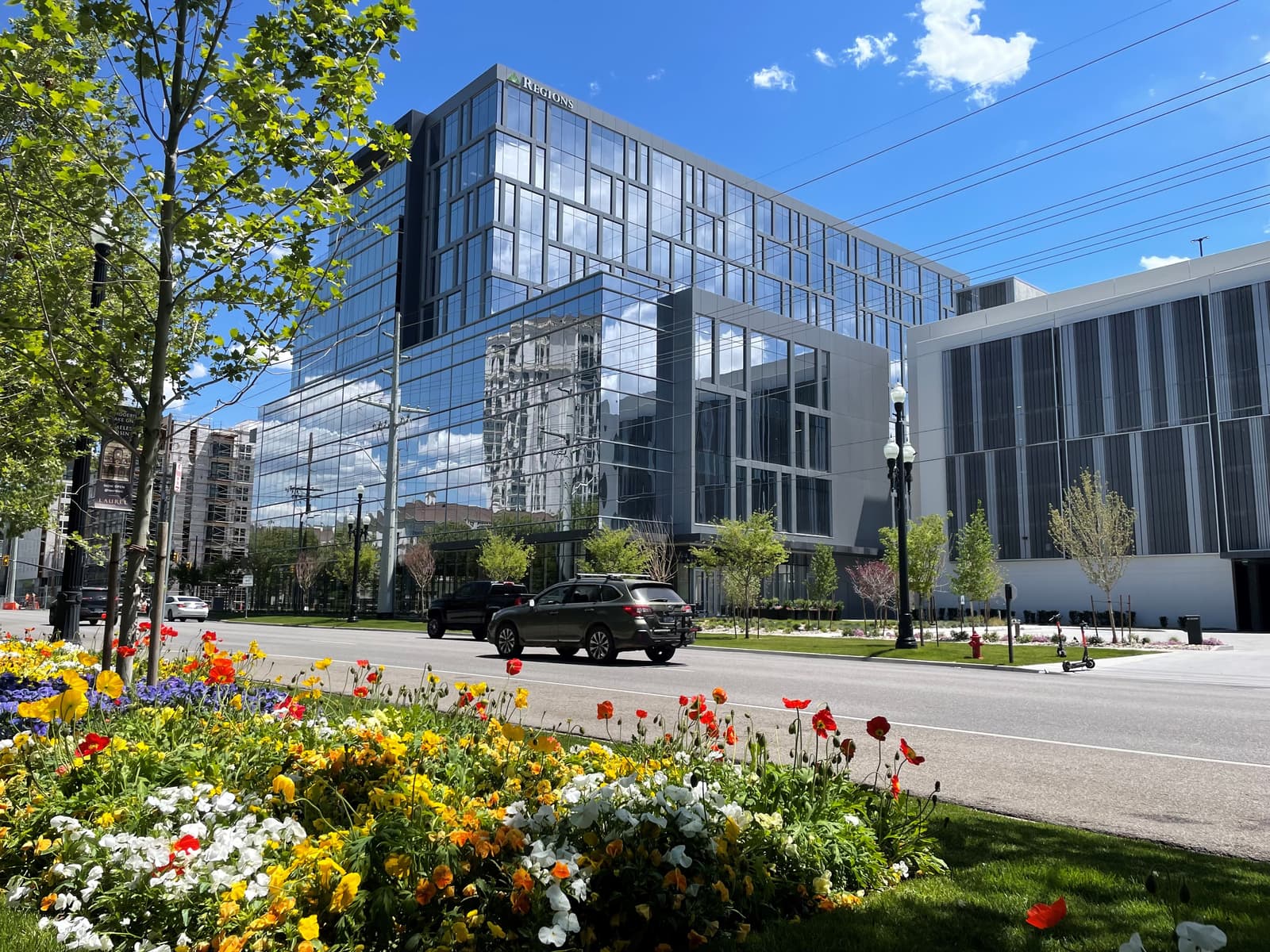
Dallas's financial district towers carry roof systems that require high-rise crane logistics, tenant security protocols, and manufacturer warranty documentation that stands up to institutional property management review. We have done this work on the towers that define the Dallas skyline.
The cluster of financial district towers along Ross Avenue and Bryan Street in downtown Dallas represents some of the most complex roofing work in the Metroplex. Bank of America Plaza at is the tallest building in Dallas and carries a roof at houses one of the largest Chase operations in the Southwest. Comerica Bank Tower at 1717 Main anchors the western end of the financial district. These buildings have institutional ownership, Class A property management standards, and tenant rosters that include banks, law firms, and financial services companies whose space is worth thousands of dollars per square foot.
High-rise crane logistics are the first challenge. A crane lift to 72 stories for Bank of America Plaza requires FAA notification for any crane height above 200 feet in the The material staging area, the crane pad, and the lift sequence have to be engineered before we mobilize — not improvised on the day of the lift.
Tenant security protocols in financial district buildings are not optional. The tenants in these buildings handle sensitive financial data and client information. A roofing crew's access to the mechanical penthouse and roof deck requires background-checked workers, escorted access through secure floor areas, and in some cases a security clearance process that the building's security director administers. We have been through this process on multiple downtown Class A buildings and we know what it requires.
Crane work on downtown Dallas high-rises is a permitted, coordinated event — not a routine equipment mobilization. The City of Dallas Traffic Management Center requires lane closure permits for crane outrigger pads on any major downtown street. A crane lift on the Main Street side of Bank of America Plaza affects traffic on Main, Commerce, and the cross streets, and those impacts have to be documented in the permit application with proposed mitigation.
FAA Determination of No Hazard is required for any crane that exceeds 200 feet AGL in Dallas airspace. The process takes 10-15 business days for routine applications, which means it has to be filed as part of pre-construction — not as an afterthought when the crane is ordered. We submit FAA notifications as part of our standard pre-construction documentation on any high-rise project.
Material staging on a downtown financial district building is constrained by the building's loading dock, the building's freight elevator capacity, and the tenant schedule for freight elevator use. Most Class A buildings in the financial district have restricted freight elevator windows — often 6 AM to 8 AM and 5 PM to 7 PM to avoid conflicts with business-hour elevator demand. We stage our material lifts inside those windows and coordinate with the property management team on the freight elevator schedule weeks in advance.
JPMorgan Chase's operation at includes trading operations and private banking functions that require controlled access to adjacent mechanical spaces. The mechanical penthouse above Chase's floors is not a space that a roofing crew can access without an escort and a background check. We submit worker credentials — name, government ID number, background check authorization — to the building's security director before any worker is cleared for access.
We have the same protocol at Comerica Bank Tower: all roofing crew members are badged through the building's security system before their first day on the project, and access logs are maintained by the building's security team throughout the project. If a worker is dismissed from the project or replaced, we notify the security director the same day so their access can be revoked.
Financial district buildings also carry tenant communication protocols. The property management team at most Class A towers sends tenant communications about any construction activity that might affect the building — noise, elevator access changes, lobby congestion from material deliveries. We provide the property management team with a weekly production update, including the next week's planned activities, so their tenant communications are accurate.