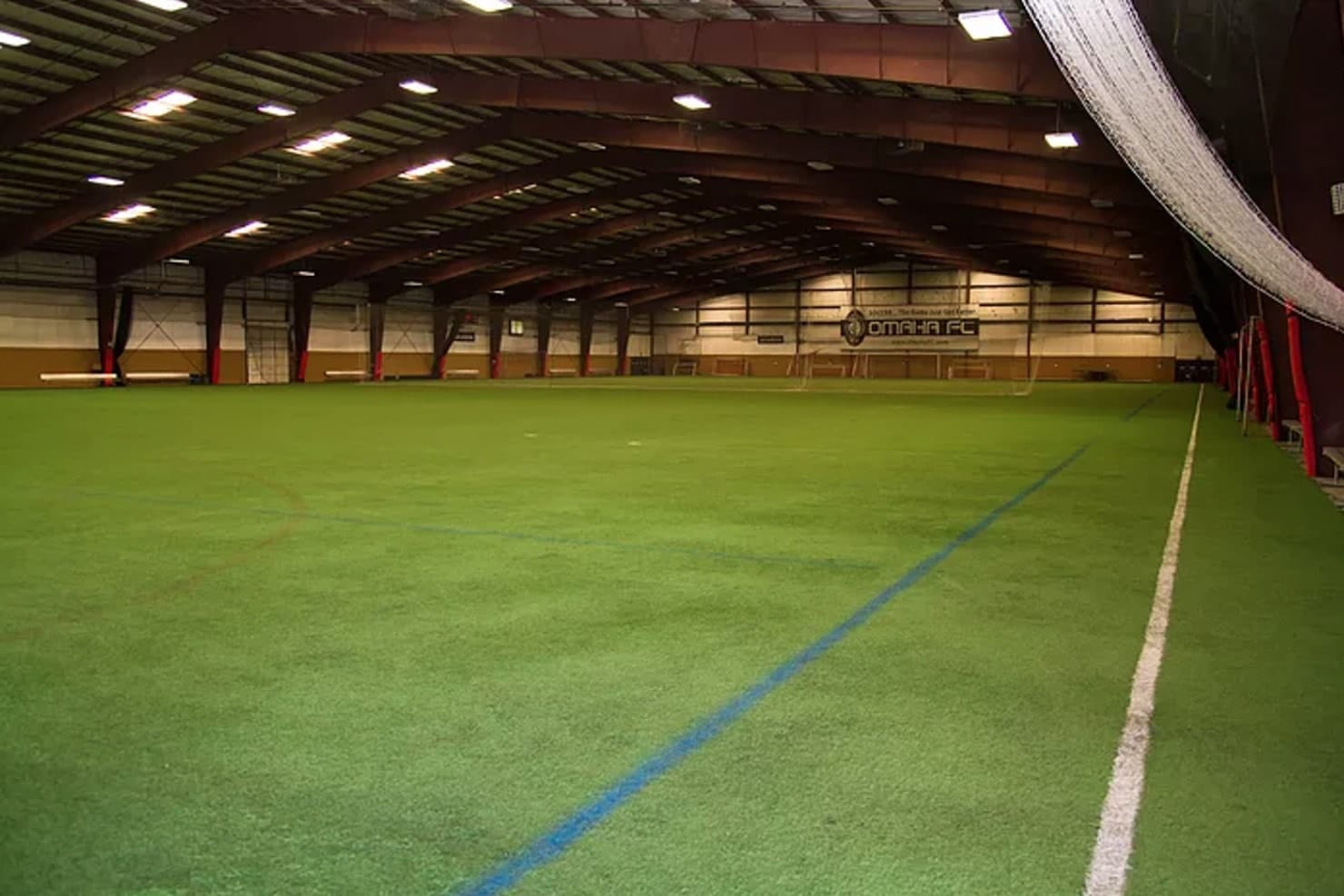
Recreation buildings ask two hard things of a roof at once: cover a wide span with no columns to help, and shrug off the moisture that hundreds of active bodies — and very often a pool — throw into the air underneath it. We roof rec centers, field houses, indoor courts, ice rinks, and aquatic centers across Dallas, and we design for the span and the humidity together, because a gym roof and a natatorium roof that look alike from the parking lot are completely different engineering problems below the deck.
Dallas runs a large public and private recreation network. The city operates more than forty recreation centers and a string of aquatic facilities through Park and Recreation, the YMCA of Metropolitan Dallas anchors the nonprofit side, and private operators have built indoor courts, training facilities, and field houses across the suburban growth rings. Add the indoor sports and entertainment venues threaded through the metro and you have a building category that is busy on exactly the evenings, weekends, and holidays when most roofers would rather be off — which shapes how we schedule every one of these jobs.
A gymnasium, court building, or arena roof typically spans well past anything a standard commercial bay would, often on steel joists or trusses carrying the load across forty, sixty, eighty feet or more with nothing underneath. That changes the fastening math. Wind uplift on a wide-open deck is unforgiving, and the fastener pull-out you can count on at a thirty-foot span over a tight column grid is not what you get at eighty feet. We evaluate the deck type and the actual span and provide the fastener specification and, where it is warranted, pull-out testing to back it, rather than dropping a generic attachment pattern on a structure that will not support it. For most long-span gym and court roofs in Dallas that means a 60- or 80-mil membrane mechanically attached over polyiso, engineered to the deck rather than to a catalog default.
The hardest roof in this category sits over the pool. A natatorium is a humidity machine — warm water evaporating into the air all day — and that moisture wants to drive straight up into the roof assembly. If the vapor retarder is missing or wrongly positioned, you get condensation inside the deck and insulation, hidden corrosion, and eventually a structural problem with no surface leak to warn you. We position the vapor control layer for the pool hall's real interior conditions and the North Texas climate, and on any reroof over a pool we run a moisture survey first, because recovering over an already-wet assembly compounds the problem instead of fixing it.
Then there is the chemistry. Chloramines — the compounds that come off when pool chlorine reacts with what swimmers bring into the water — are aggressively corrosive to ordinary metal flashing, aluminum edge metal, and some adhesive formulations. Over a natatorium we specify stainless or copper flashing in the chloramine-exposed zones, confirm the membrane against the manufacturer's chemical-resistance data, and choose adhesives proven for pool-hall environments. The exhaust side gets attention too: ventilation should carry that corrosive air out of the building rather than recirculating it above the pool envelope, and we coordinate any work near those exhaust paths with the pool operations team.
Rec centers and field houses love daylight, which means skylights and translucent panels — and those are perennial leak sources on aging buildings. We treat curb-mounted skylights and panel systems as their own flashing details, evaluate the curb and the surrounding membrane together, and reseal or replace rather than chasing the same drip season after season.
These buildings are booked. League play, lap swim, camps, and rentals fill evenings and weekends, and the roof work has to fit around the calendar rather than shut the doors. We pull the programming schedule from facility management and concentrate gym and arena roof work into weekday daytime hours, confirming dry-in before evening programming starts. For aquatic facilities we work with the pool operations staff on any exhaust or HVAC penetration work that could briefly affect the air exchange over the pool, and sequence it so the natatorium environment stays controlled.
How the work gets contracted depends on who owns the building. City rec centers, school gymnasiums, and park-district facilities run through public procurement — advertised bids, bid and performance bonds, and prevailing-wage compliance where it applies — and we carry the bonding and insurance and handle the documentation that public work in Texas requires. Private clubs, YMCAs, and sports-entertainment venues take a different contracting path but usually carry their own tight scheduling constraints around memberships and event calendars. We have worked both sides and can match the process to your facility.
Whether you operate a city rec center, a natatorium, a private field house, or an indoor court complex, we can assess the span and the moisture picture, survey for hidden assembly moisture over the pool, and lay out a specification and a programming-aware schedule that fits how the building is actually used. We will walk the roof, the pool hall, and the skylights and give you a straight plan.
Most long-span gym, court, and arena roofs in Dallas use a 60- or 80-mil membrane mechanically attached over polyiso, but the attachment has to be engineered to the actual deck and span. The fastener pull-out you get on steel deck at eighty feet is different from the same deck at thirty, so we evaluate the deck type and span and provide the fastener specification — with pull-out testing where it is warranted — rather than applying a generic pattern to a wide-open structure.